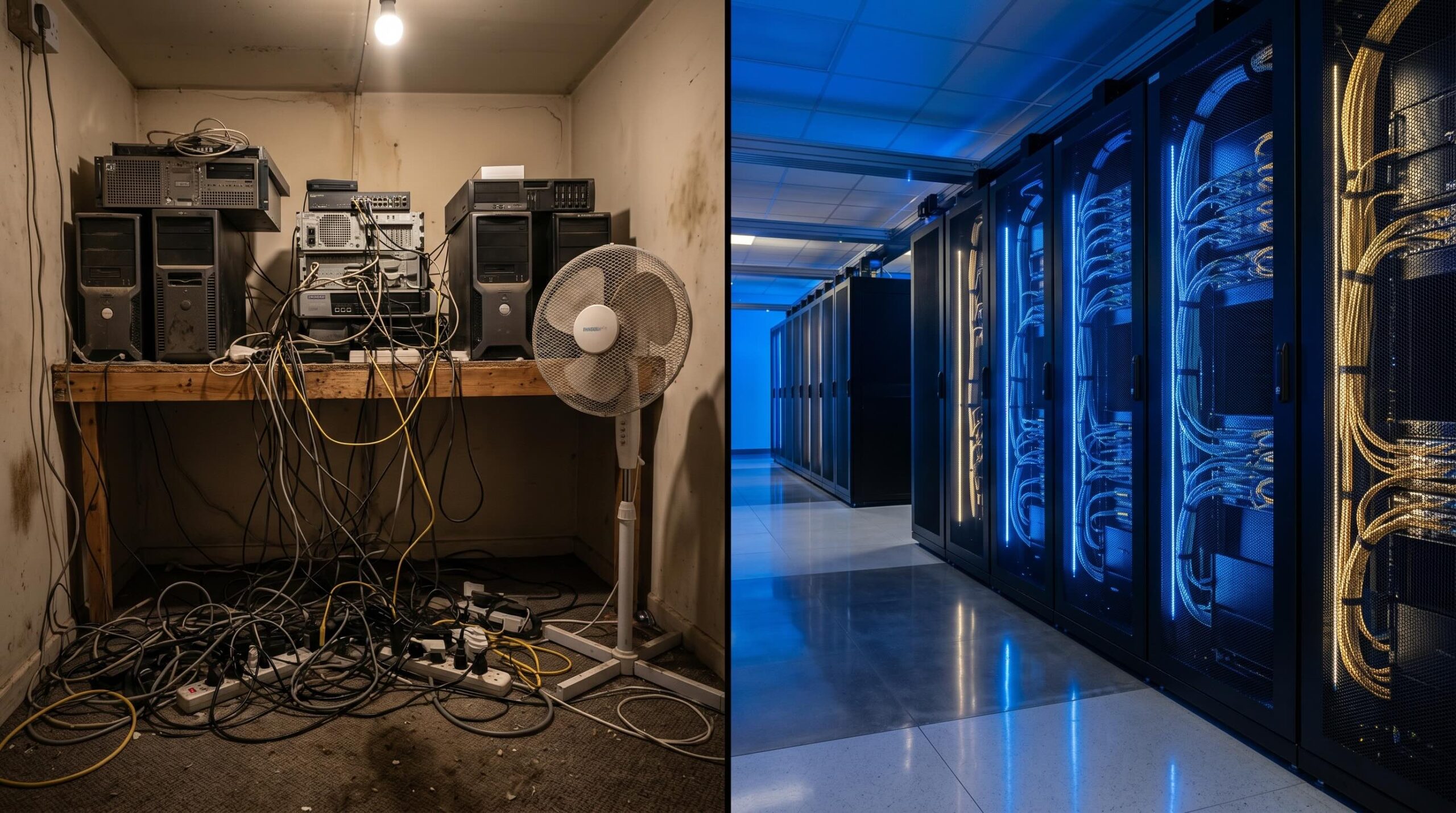
In the early stages of a business, the "server room" is often just a repurposed broom closet or a corner of the breakroom. It’s local, it feels cost-effective, and it’s right there when you need to "just hit the reset button." However, as we move through 2026, the technological demands on infrastructure have far outpaced the capabilities of the average office environment.
For growing Australian firms, the decision to remain on-premise isn't just a technical choice—it's a significant business risk. High-density AI workloads, increasing utility volatility, and sophisticated physical security threats have made the office "server cupboard" a liability.
Here is why your on-premise server room might be the biggest hurdle to your brands growth strategy.
1. The Power and Cooling Fragility
Modern hardware, particularly the high-performance CPUs and GPUs required for modern applications, generates immense heat. Standard office air conditioning is not designed for the 24/7 high-intensity thermal load of a server rack.
Redundancy is Not an Option
In a professional colocation environment, power is backed by massive Uninterruptible Power Supply (UPS) systems and diesel generators. In an office, a simple localised power cut or a tripped circuit breaker can result in hours of downtime and potential data corruption. Without N+1 or 2N redundancy, you are one blown fuse away from a total business standstill.
2. The Insurance and Compliance Burden
In 2026, cyber insurance providers have become much more stringent about where physical data is stored. Storing sensitive customer information or proprietary IP on a server in an unlocked office room is often enough to void a policy or significantly increase your premiums.
The Insurance Cost of On-Prem
Insurance adjusters now look for physical security certifications that standard offices simply cannot meet. Professional data centres provide the audit trails, biometric access logs, and 24/7 surveillance required to satisfy the most demanding compliance standards (like SOC2 or IRAP). Moving to colocation often pays for itself simply through reduced insurance overhead and an improved compliance posture.
3. Physical Security Gaps
While we often focus on digital hacking, the physical theft of a server is the fastest way to suffer a total data breach. Most office security consists of a front door lock and a basic alarm.
In contrast, professional Sydney data centre facilities utilise multi-layered security perimeters. From biometric palm scanners to anti-tailgating man-traps and 24/7 on-site security personnel, your hardware is protected by a fortress-grade environment that no office can replicate.
4. The "Single Point of Failure" Technician
When you run your own server room, you are often dependent on a single internal IT person or a small local MSP. If a server fails at 2:00 AM on a Sunday, your recovery time is limited by how fast that person can drive to the office.
Professional colocation provides "Remote Hands" services—expert technicians who are already on-site 24/7. Whether it’s a simple hard drive swap or a full system reboot, support is minutes away, not hours.
5. Scalability and the "Success Tax"
Growth requires space, power, and bandwidth. If your business wins a major contract and needs to double its compute capacity, an on-premise room is a bottleneck. You cannot easily pull more power from the street or upgrade the building's cooling capacity without a massive capital expense (CapEx).
Colocation transforms this into an operational expense (OpEx). Need another rack? It’s ready. Need 30kW of power for a new AI cluster? The infrastructure is already built to handle it.
The office server room was a viable solution for the 2010s, but in 2026, it is a liability. By moving your critical infrastructure into a professional Sydney data centre, you eliminate the physical risks to your data and free your team to focus on innovation rather than fire-fighting.
Is your office infrastructure holding you back?
Secure Your Infrastructure Future
Book a Data Centre Tour & Colocation Audit today. Let us show you how relocating your servers can lower your risk and unlock your business growth.