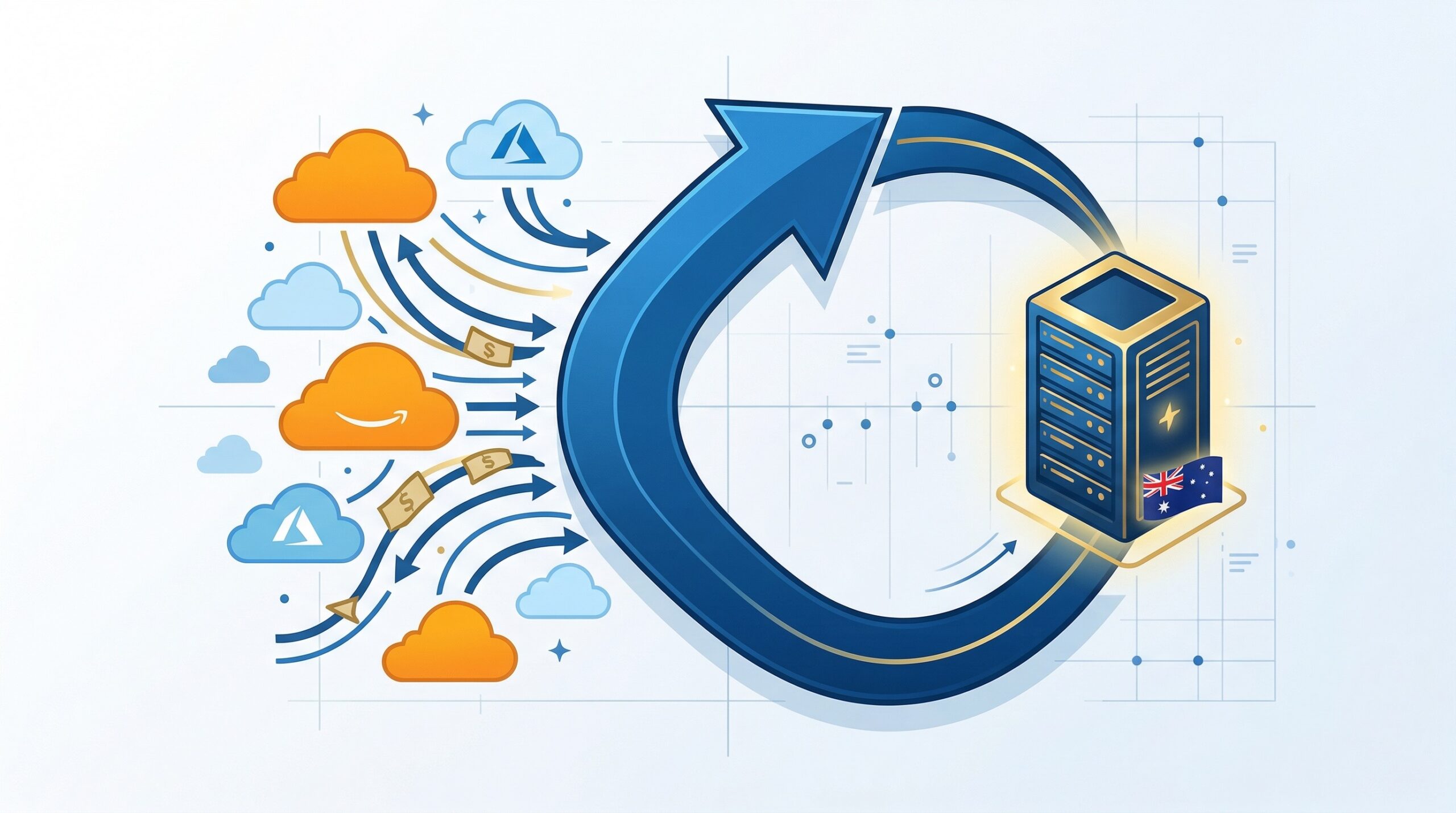
For a decade, the narrative was simple: "Move everything to the public cloud." In 2026, that narrative has been completely rewritten. We are now witnessing The Cloud Reset.
According to recent industry data, nearly 80% of enterprises have either initiated or are planning a cloud repatriation strategy—the process of moving specific workloads away from public hyperscalers like AWS, Azure, and Google Cloud, and back to Private Cloud or on-premise infrastructure.
At Amaze, we’ve watched this trend accelerate among Australian SMBs. The "cloud-first" mantra has been replaced by a "cloud-smart" reality, where financial predictability and performance, delivered via CloudCore Private Cloud, are the new priorities.
The FinOps Reality Check: When Public Cloud Costs Spiral
The primary driver of repatriation in 2026 isn't technical—it's financial. The discipline of FinOps (Cloud Financial Operations) has matured, and it has exposed a painful reality: the public cloud is exceptionally expensive for steady-state, predictable workloads.
The Problem with Hyperscaler Pricing
Hyperscalers excel at variable, bursting workloads (e.g., launching a new app or handling Black Friday traffic). However, once a workload becomes stable, the tiered pricing models of public clouds become a "success tax."
The more resources you use, the more complex the billing becomes. In 2026, IT departments are spending more time managing complex "Reserved Instance" marketplaces and spot instances than they are managing their actual infrastructure.
H3: The Hidden Killer: Data Egress Fees

The most significant "gotcha" in public cloud billing remains data egress fees. These are the charges levied by hyperscalers simply to move your data out of their environment.
In a hybrid or multi-cloud setup, these fees can represent up to 30% of the total cloud bill. For Australian businesses, moving large datasets between a Sydney hyperscaler region and a local office can decimate IT budgets.
The Solution: Predictable Performance with CloudCore Private Cloud
Cloud repatriation is not about abandoning the cloud; it's about optimizing where workloads live. CloudCore offers a high-performance Private Cloud environment that solves the predictability crisis.
Flat-Fee Predictability
Amaze CloudCore operates on a transparent, flat-fee model. You know exactly what your infrastructure costs will be at the start of the month, regardless of how much data you transfer or how heavily your CPUs are utilized. This allows for accurate long-term budgeting and linear cost scaling.
Eliminating "Noisy Neighbours"
Public clouds are multi-tenant environments. If another customer on the same physical hardware experiences a traffic spike, your application’s performance can suffer—the "noisy neighbour" effect.
With CloudCore Private Cloud, you have dedicated resources. Whether you utilize DataHaven colocation or our managed IaaS, the performance is consistent, single-tenant, and optimized for your specific applications.
Taking Back Control of Your Infrastructure
The "Cloud Reset" of 2026 is a healthy correction. It represents a move away from ideological "cloud-first" deployment toward pragmatic, ROI-driven infrastructure strategy.
By repatriating steady workloads to a local, high-performance Private Cloud with Amaze, you aren't moving backward—you are taking control of your financial and technical destiny.
Is hyperscaler sticker shock hurting your bottom line?
Calculate Your Savings
Book a free TCO audit with Amaze today to see how much you can save by switching to CloudCore.
This article was technically reviewed for 2026 FinOps accuracy by Luke Iggleden, CEO at Amaze.au. Data regarding repatriation trends is based on 2025/2026 market analyses of infrastructure spending.